
Post X: the invisible system behind filmmaking is being rewritten
Post-production has become one of the most complex stages in filmmaking, yet the tools supporting it remain fragmented. Leonard Domínguez, a post producer working across films and series in Mexico, encountered that gap firsthand while managing high-pressure projects with heavy VFX demands. What started as a practical internal solution evolved into Post X, a platform that unifies workflows, centralizes information, and structures processes that typically operate in silos. Built from the realities of Latin America, Post X positions itself as a new operational standard for post-production.
You've spent years working as a post producer on films and series in Mexico. What specific frustrations from that experience pushed you to build Post X?
Last year, I came across one of those challenges that make you rethink everything. I'm working on a Netflix project that is still in post-production and carries a very heavy VFX load, and at a specific phase of the process, we had to deliver an enormous amount of documents to the teams responsible for executing the VFX, in under a week, with no time and not enough hands.
I was somewhat stuck trying to find a faster and more effective way to get it done, and I remember very clearly my father-in-law, who is an engineer and works with systems and software, telling me: “Of course, there's a way to solve it, remember you're working with pure data.” That unlocked something for me. I sat down and built a small piece of software that used exactly that information as a database and solved the problem immediately. That's when I asked myself: why not do this for all post-production management?
Because the gap exists. The craft only consolidated in the early 2000s and has become increasingly complex, yet the post producer, the person who oversees every department and has to hold the complete big picture, still has no unified tool. The ones that exist are scattered, forced into the role, and don't feel natural in that position. Post X was born from that, with the ambition of standardizing post-production management across Latin America.
You describe Post X as an operating system for post-production. In real terms, what does that change for a team in the middle of a project?
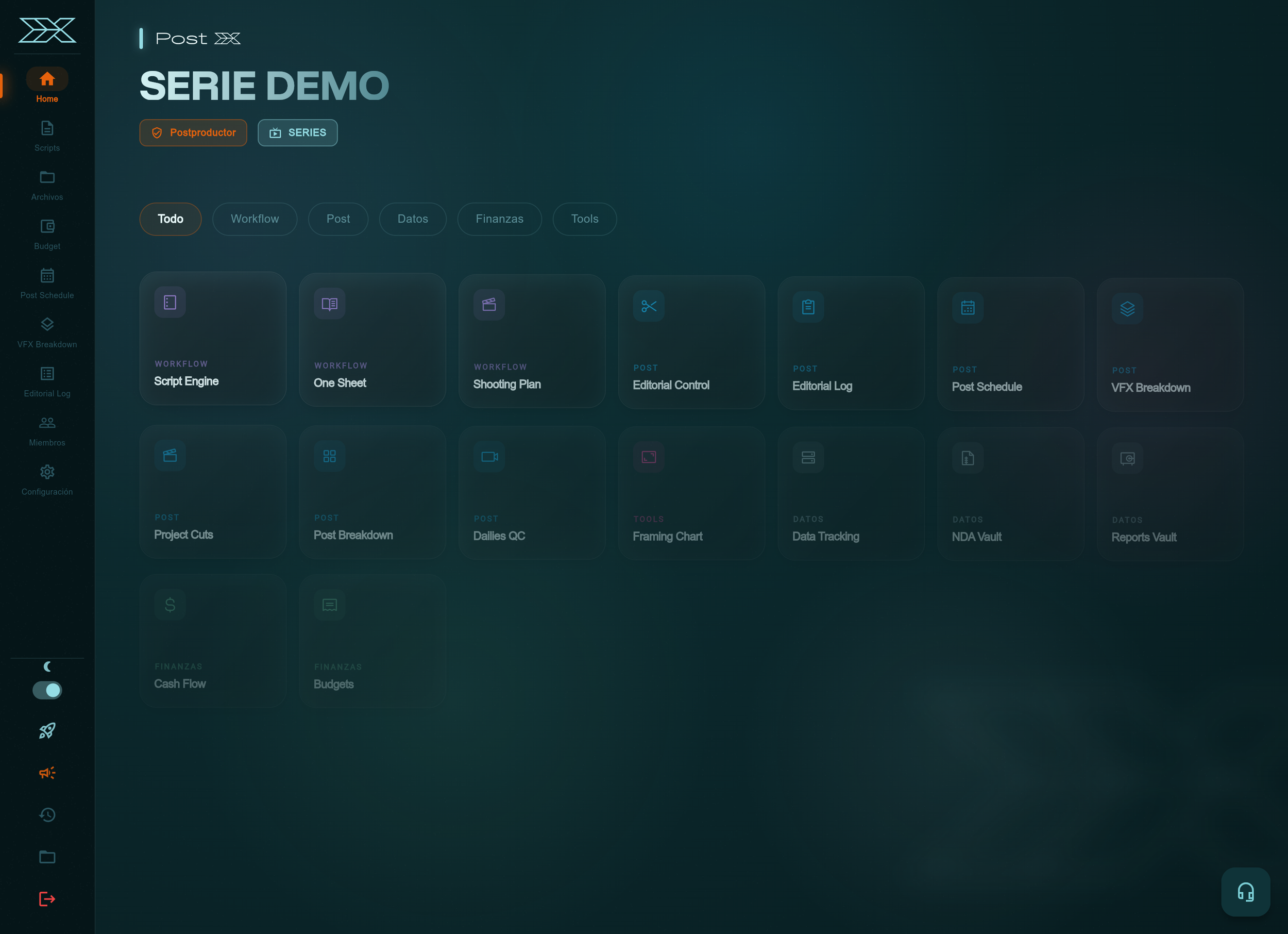
The first thing that changes is having all the information concentrated in one place. Post-production management is typically handled through functional tools that never communicate with each other. The foundation of Post X is keeping the most relevant information connected for the post producer throughout a project, from pre-production and production all the way through post. When you have all of that concentrated, you can always see the big picture: the workflow, the calendar, the status of every department.
It changes everything because ultimately, it's about not losing information. And there's something important here: post-production rarely has a large team managing the volume of data that production might have; it's a smaller group carrying an enormous amount of information. Editing, VFX, Sound, Music, Color, Stock, Clearances, Licenses. All those departments run in parallel. An agreed date, a small but critical detail, if it only lived in an email, nobody remembers it months later. That's not negligence, it's what happens when information lives scattered. Post X exists to have a single source of truth in one place.
Post X is built from within the realities of LATAM. What are the biggest gaps you saw in existing tools that simply don't translate to this region?
They do work in their own way, but they don't coexist with each other. I found myself in very common situations: 15, 20, 30 open tabs just to have all the information for one production. That's normal; there are human errors, communication errors, and the more scattered the information is, the more natural it is that something gets lost.
There are also management tools like Monday or Asana, but they're generalist; every project must be configured from scratch, every team changes, and not everyone feels comfortable with them. A lot of the time, part of the team experiences it as bureaucracy. And that's another gap: those tools don't speak the language of post-production.
Beyond that, Latin America works in very different ways. Historically, we've adapted to Anglo tools; some work, others not so much, because budgets, workflows, and even the way films are made vary by country. Each has its own work culture, its own way of executing every step in building a film or television project. The way a country makes cinema is a culture in itself. What I'm looking to do with Post X is create a post-production standard for Latin America, one that carries the DNA of how we work, of our context, that feels native to this side of the industry, and that speaks a language everyone inside it can navigate.
One of your core ideas is bringing traceability and control into a process that usually runs in chaos. What shifts when a production finally has that level of visibility?
A sense of control and peace. And you also feel better prepared for the unexpected, which never stops happening in this industry. The more projects I do, the more I feel that each one is a universe of its own, each has different needs, its own problems, its own advantages, its own people. You always meet someone new, you work with people who think in completely different ways, and that enriches every project I'm part of. That's why it's so compelling. It's impossible to get bored. No film has ever been made under the same rules, the same map, or the same workflow.
And that's exactly where visibility matters most, on the post-production side, but also on the human side. Communication cannot be underestimated in any aspect. That's also why Post X exists. It's a tool I consider deeply personal, from how it came to be to how it brings part of my own personality into this industry.
From your perspective inside the industry, where is post-production in Latin America heading, and what role do you want Post X to play in that future?
We're at a historic moment from a technological standpoint. AI tools have arrived, they're becoming increasingly intelligent and adaptable, and there are fearful perspectives alongside optimistic ones. It's a delicate era, but a historic one. And my view is that all of this should push us to be more creative. I hope I'm not wrong, but AI is not going to replace human creativity, or the drive that comes with it.
Post-production is at a stage where it must take advantage of what these technologies bring and restructure itself. The soul of creation will always be creativity, especially in an industry that has achieved what it is today because of it. The artificial cannot be the foundation, and it won't be, but it has arrived to help, and that's a very different conversation.
Post X is my response to something that genuinely didn't exist, and thanks to many things we now have at our disposal, I can shape it and turn it, together with my creativity and experience, into a necessary tool. One that brings together much of what this industry needs and aims to become the standard in film and television post-production across Latin America. Post X is part of that future.